
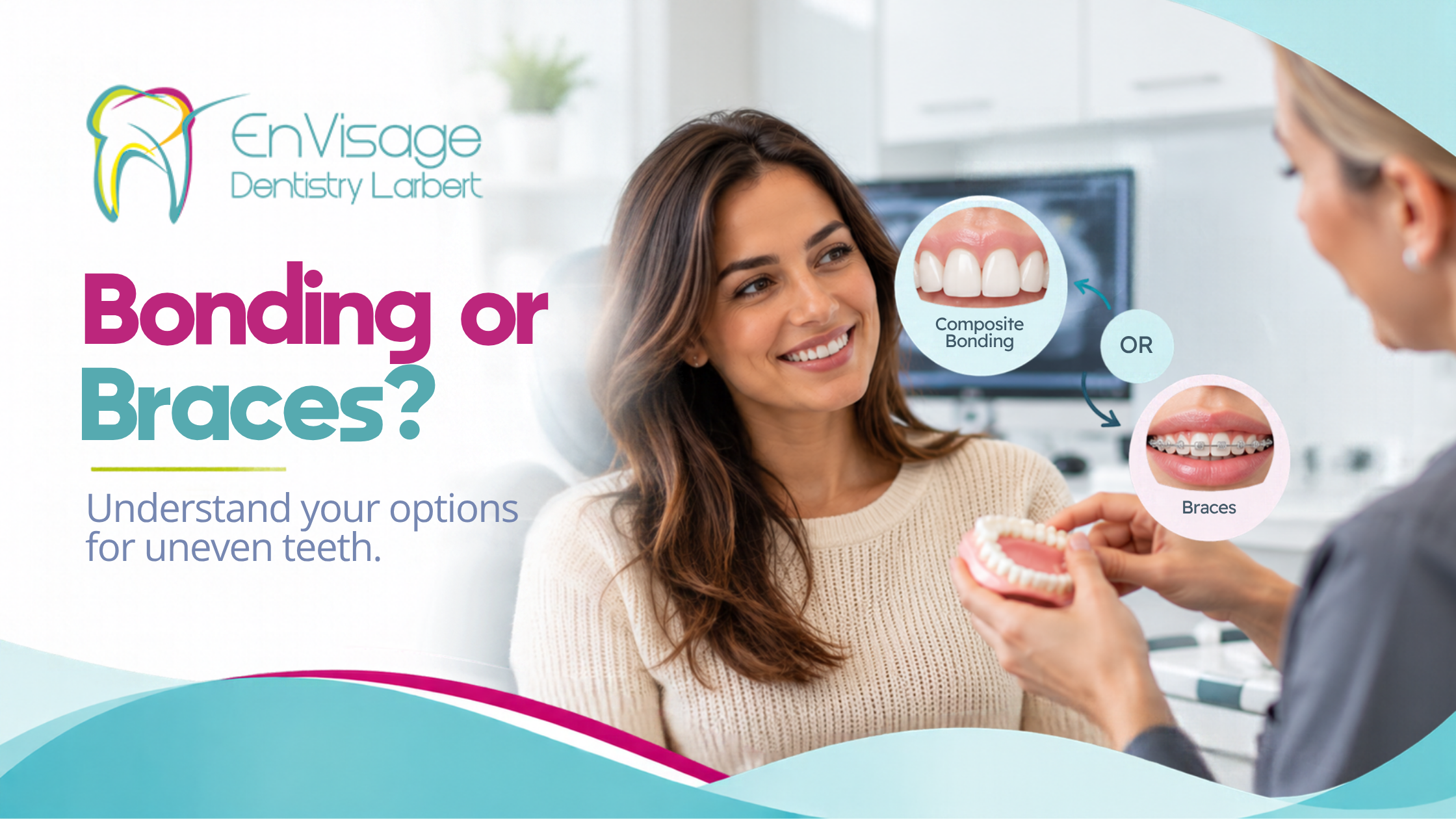
If your teeth are slightly uneven, you may be wondering whether composite bonding could improve their appearance without needing braces. Perhaps one tooth looks shorter than the others, the edges appear irregular, or you have a small gap that you would like to change.
Composite bonding can be a suitable option for some of these concerns. It uses tooth-coloured composite resin to reshape selected areas of a tooth, helping improve its appearance. However, it is important to understand one key difference: bonding changes the shape of a tooth, while orthodontic treatment moves teeth into a different position.
This means bonding may help with minor differences in tooth shape or small gaps, but it cannot correct every type of crookedness, crowding or bite problem.
If you are considering composite bonding in Larbert, understanding the differences between bonding and braces can help you have a more informed conversation with your dentist. The most suitable treatment depends on how your teeth are positioned, your bite, your oral health and the result you hope to achieve.
What is composite bonding?
Composite bonding is a dental treatment in which a tooth-coloured composite resin material is applied to selected areas of a tooth and shaped to improve its appearance.
The material can be used to address certain cosmetic concerns, including:
- Small chips or worn edges.
- Minor differences in tooth length or shape.
- Small gaps between teeth in suitable cases.
- Uneven edges that affect the appearance of your smile.
- Some minor imperfections in the visible surfaces of teeth.
Your dentist selects and shapes the material to complement your natural teeth. The aim is to create a result that looks balanced rather than making every tooth look identical.
Bonding is often considered for relatively small changes because it can sometimes be completed without removing much, or any, natural tooth structure. However, the amount of preparation needed depends on the tooth and the treatment plan.
It is not suitable for every cosmetic concern, and the result depends on the starting position and condition of the teeth.
Can composite bonding make crooked teeth look straighter?
In some cases, yes. Composite bonding may improve the appearance of teeth that look slightly uneven, provided the underlying positioning allows a suitable result.
For example, if one front tooth has a small chip or its edge is slightly irregular, adding composite material may help create a more even outline. If a tooth looks shorter than its neighbour, reshaping the visible edge may improve the balance between them.
However, bonding does not move a tooth within the jaw. It adds material to change the visible shape, so it cannot genuinely straighten a tooth that is significantly rotated, crowded or out of position.
Adding too much material to compensate for a pronounced misalignment can also make a tooth look bulky or affect how your teeth meet when you bite.
Your dentist will assess whether bonding can achieve a natural-looking result without creating problems with your bite or making cleaning more difficult.
What types of uneven teeth might bonding help with?
mall chips and irregular edges
A chipped edge can make a tooth look uneven even when its position is otherwise normal. If the damage is minor and the tooth is healthy enough to restore, composite bonding may be used to rebuild the missing area.
The dentist will first assess the extent of the damage and check whether there is an underlying problem that needs treatment.
Small gaps between teeth
Bonding can sometimes reduce the appearance of a small gap by adding carefully shaped composite material to the sides of selected teeth.
However, not every gap is suitable for this approach. Closing a larger gap by adding material may make the teeth look too wide or change the proportions of your smile.
Gaps can also have different causes, including tooth position, missing teeth or changes in the gums. Your dentist may recommend orthodontic treatment or another option depending on the reason for the gap.
Uneven tooth lengths or shapes
Teeth naturally vary in shape and size. If one tooth appears shorter or has an irregular edge, bonding may help create a more balanced appearance.
This is different from correcting a tooth that sits higher, lower or further forward than the surrounding teeth. Where the difference is caused by position rather than shape, orthodontics may be more appropriate.
Mild visual asymmetry
Small differences between the front teeth may sometimes be improved through careful reshaping with composite resin. The dentist must consider the width, length and position of the teeth together, rather than treating one tooth in isolation.
A good outcome depends on achieving a result that suits your smile and maintains healthy tooth proportions.
When are braces or orthodontics a better option?
If your teeth are genuinely crooked, crowded or significantly out of alignment, orthodontic treatment may be more appropriate than bonding.
Braces and other orthodontic appliances apply controlled forces to move teeth into different positions over time. Depending on the problem, orthodontic treatment may help improve the alignment of your teeth and the way your upper and lower teeth meet.
Orthodontics may be worth discussing if:
- Several teeth overlap or are crowded.
- One or more teeth are noticeably rotated.
- Teeth sit significantly further forward or backwards than others.
- Your upper and lower teeth do not meet comfortably.
- You have gaps that are too large to close naturally with bonding.
- You want to change the actual position of your teeth rather than their visible shape.
Orthodontic treatment takes time, and the duration depends on the complexity of the problem. Your dentist can explain whether braces or another orthodontic option may be suitable and what the process could involve.
Although bonding may appear quicker, it is not always the simpler or more appropriate long-term choice. The aim should be to choose treatment that addresses the underlying concern, not simply the option that involves fewer appointments.
Composite bonding vs braces: what is the difference?
The main difference is what each treatment changes.
|
Consideration |
Composite bonding |
Orthodontic treatment |
|
Main purpose |
Changes the visible shape of teeth |
Moves teeth into different positions |
|
Suitable concerns |
Minor chips, small gaps and uneven edges in suitable cases |
Crowding, rotations, misalignment and certain bite problems |
|
Treatment approach |
Composite resin is shaped onto selected teeth |
Braces or other appliances apply forces to move teeth |
|
Typical timescale |
May be completed in one or a few appointments, depending on the case |
Usually takes months, and sometimes longer, depending on complexity |
|
Maintenance |
Bonding may chip, stain or need repair over time |
Retainers are usually needed to help maintain tooth positions after treatment |
|
Limitations |
Does not straighten the roots or correct significant misalignment |
Requires commitment to the treatment plan and good oral hygiene |
Neither option is automatically better. They address different problems, and in some cases your dentist may discuss a combination of treatments.T
Could I need both orthodontics and composite bonding?
Yes, some patients may benefit from a combination of treatments, although this depends on their individual needs.
For example, orthodontics may first be used to improve the position of crowded or rotated teeth. Once the teeth are in a more suitable position, bonding might be considered to repair a small chip or refine an uneven edge.
This approach can sometimes reduce the amount of composite material needed and help create a more balanced result.
The order matters. If you are considering both treatments, discuss the overall plan with your dentist before starting bonding. This allows the position of the teeth, the final shape and any future treatment to be considered together.
If you are also thinking about teeth whitening, discuss the order of treatment before proceeding. Composite material does not whiten in the same way as natural teeth, so whitening may be considered before bonding when appropriate.
Does composite bonding damage your natural teeth?
Composite bonding can often be carried out with little or no removal of healthy tooth structure, but this is not guaranteed in every case. Some teeth may require preparation to achieve a suitable shape, fit or finish.
Before treatment, ask your dentist how much preparation is expected and whether there are alternatives that would preserve more natural tooth structure.
Bonding is also not a permanent, maintenance-free solution. Composite resin can chip, wear or become stained over time. You may need polishing, repair or replacement in the future, depending on the location of the bonding, your bite and your everyday habits.
Looking after your teeth, avoiding using them to bite hard objects and attending regular dental check-ups can help maintain your restoration.
What happens during a composite bonding consultation?
If you are considering composite bonding in Larbert, the first step is an assessment of your teeth and what you would like to change.
Your dentist will examine the teeth involved, assess your bite and check your oral health. They will consider whether the unevenness comes from the shape of the teeth, their position or a combination of both.
You can use the consultation to discuss:
- Which teeth you would like to improve.
- Whether bonding could create a natural-looking result.
- Whether orthodontic treatment would address the concern more effectively.
- How much preparation may be needed.
- The expected lifespan and maintenance of the bonding.
- The likely cost and any suitable payment options.
At Envisage Dentistry Larbert, a free cosmetic consultation is available. The practice offers composite bonding and cosmetic braces, so you can discuss the options with the dental team and understand which approach may suit your needs.
The consultation is an opportunity to explore your options. You do not need to commit to treatment before you understand the proposed plan.
Considering composite bonding in Larbert?
If you have slightly uneven teeth, small chips or gaps, composite bonding may be one option worth exploring. However, if your teeth are crowded or significantly out of position, orthodontic treatment may provide a more appropriate solution.
At Envisage Dentistry Larbert, the team can assess your teeth and discuss cosmetic bonding, cosmetic braces and other relevant options based on your individual circumstances.
The practice is located at 154 Main Street, Stenhousemuir, Larbert, FK5 3JP. It welcomes new patients and offers a free cosmetic consultation. The practice also advertises 0% APR finance options, subject to eligibility and the applicable terms.
To discuss your options, contact Envisage Dentistry Larbert on 01324 562910 or visit the practice website.
The best starting point is a clear understanding of what you want to change and which treatment can achieve it while supporting your long-term oral health.
Frequently asked questions
Can composite bonding straighten crooked teeth?
Composite bonding can improve the appearance of mildly uneven teeth by changing their visible shape, but it does not move teeth into a new position. If teeth are significantly crooked, rotated or crowded, orthodontic treatment may be more suitable.
Is composite bonding quicker than braces?
Bonding may be completed in one or a few appointments, depending on how many teeth need treatment. Orthodontic treatment usually takes much longer because teeth move gradually. However, the quicker option is not necessarily the most appropriate one for every concern.
Is composite bonding suitable for gaps between teeth?
Bonding can sometimes reduce the appearance of small gaps by adding composite material to the sides of the teeth. Larger gaps or gaps caused by tooth position may be better addressed with orthodontics or another treatment. A dentist can assess which option is suitable.
How do I choose between composite bonding and braces in Larbert?
A dental assessment can help establish whether your concern relates mainly to tooth shape or tooth position. Your dentist will consider your bite, oral health and desired outcome before explaining whether bonding, orthodontics or a combination may be appropriate.